Santa Cruz and Gilroy Winery Visits - April 2026
The impetus for this mid-April day-trip to visit three wineries in Santa Cruz and Gilroy was to see vintner Megan Bell, who was closing down her Margins Wine label. I wanted to make sure that I got to her tiny tasting room in Santa Cruz before it closed a few weeks following our visit. My friends Wes and Larry were interested in joining me, and we were able to arrange two more winery visits on the same Sunday, at Madson Wines and at Deauratus Wines.
Madson and Margins are located very close to one another in Santa Cruz, and we visited both of them in the morning and around mid-day, and then had lunch right around the corner from Margins before driving eastward over the hills to Gilroy, where Deauratus is located.
The Bay Area had a fair amount of much-needed rain that weekend, and I drove through frequent showers on my way to meet up with Wes and Larry and Wes’ house in Mountain View. Fortunately for us, the rain had stopped by that time, and Larry was kind enough to drive that day so we all got into his car for the rest of our journey to Santa Cruz.
Madson Wines
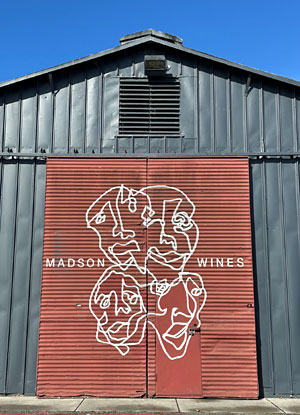
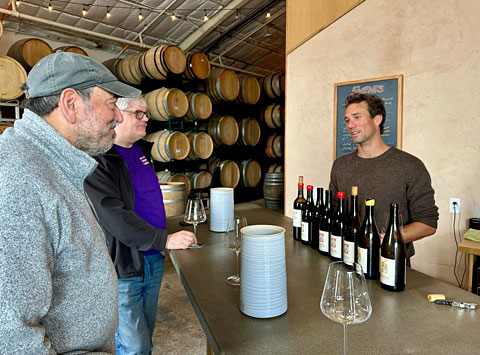
Wes, Larry, and I arrived a little early but after just a few minutes Madson Wines co-proprietor and winemaker Cole Thomas opened up the large metal sliding doors to the winery space to greet us. Madson is a partnership between Cole and his friends and wine colleagues Ken Swegles and Abbey Chrystal. I’d first learned about them some years ago when I’d met Ken – each harvest season he’s brought in fruit from several Santa Cruz Mountains vineyards he manages to wineries where I’ve worked part-time. Madson’s winery and tasting room are located in an industrial steel building just off Ingalls Street in Santa Cruz – there are a number of other wineries, breweries, bakeries and cafés, and other small businesses within a couple of blocks of one another along the street. The large doors that lead to the winery space are painted with the Madson “Four Faces” image – this represents the continuing cycle of the four seasons, both in the vineyard and in the winery. We followed Cole inside, and he began lining up bottles on the tasting bar that’s located in a corner of the winery space. He had been kind enough to meet with us on the morning we visited – he was heading to the annual Pebble Beach Food & Wine event later that morning (Ken and Abbey were already there) to help pour the Madson wines there.
Cole is the lead winemaker at Madson, while Ken focuses mostly on vineyard management and Abbey also manages a few vineyards in addition to other work for the label – they’ve each had years of experience with many aspects of winemaking and viticulture. All three are connected through their time working for Jeff Emery at Santa Cruz Mountain Vineyard, one of the region’s most notable longtime producers – both Cole and Ken became assistant winemakers there. College at UC Santa Cruz led Cole to working for its organic farm and then to helping create the biodynamic Demeter Seed Library. It was during an event for that organization that he first met Jeff and began his winemaking journey. In the years since, Cole has worked at Paringa Estate in Australia and at Prophet’s Rock and Amisfield in New Zealand as well as in the Santa Cruz Mountains.
|
| Wes and Larry with Cole Thomas |
Ken is widely recognized as one of the Santa Cruz Mountain’s premier vineyard managers and runs his own Skyline Viticulture business in addition to his work at Madson. He studied viticulture at UC Davis, and has worked for noted wineries including David Bruce, Rhys, and Williams Selyem. Abbey attended grad school at UC Santa Cruz and worked with Randall Grahm at Bonny Doon – in addition to her role with Madson, she also works in wine sales for Vintage 59 Imports. Assistant winemaker Tino Paccione rounds out the Madson Wines team. The label was established in 2018, though Cole and Ken had already been making a little wine together for a few years. The winery name comes from the maiden name of Cole’s grandmother. The initial vintages were made at the Santa Cruz Mountain Vineyard facility and then in Corralitos before moving to their current location in 2022.
One of the things that the Madson team is most proud of is their part in helping to convert a number of vineyards in the Santa Cruz Mountains and elsewhere to organic farming. These days making a transition to organic viticulture is not so unusual but when Cole and Ken began doing that it was much less common. And as you might imagine, two younger guys trying to convince longtime grapegrowers who had been farming conventionally to change their ways was not an easy task. But they’ve kept at it, attracting other like-minded people to do it as well, and the percentage of Santa Cruz Mountains vineyards that are organically farmed keeps growing. Madson currently sources fruit from about 15 vineyards, all of them organically-farmed (and most of which they manage) and nearly all of them located in the Santa Cruz Mountains. The vineyard sites are all fairly small and relatively close to either the Pacific coast or San Francisco Bay, with elevations ranging from 400 feet to 2,400 feet and featuring a variety of aspects and soil types. Cole told us that they prefer vineyards in cooler-climate areas, as those sites allow for a longer harvest season and slower ripening so they can really zero in on when they want to pick the fruit.
Winemaking at Madson is low-intervention, and uses all native fermentations. The wines are lower alcohol than most from California – low alcohol in and of itself is not their goal but the higher acidity that goes with it is an element in how they want their wines to express the vineyard sites they work with. Cole told us that they use whole-cluster fermentations for most of their red wines. He said they started doing that based on fermentation trials at the winery, as well as to do something different from what was typical at the time they started, to set themselves apart. He noted that not every variety or every vineyard works well for whole-cluster fermentation. For example, Cole pointed out that some vineyards with heavier soils can lead to stems staying greener even as the fruit ripens, while other sites with thinner soils often lead to stems lignifying, which is preferable for using whole clusters. Barrel-aging is typically in older French oak. Cole mentioned that they’ve started doing a rack-and-return during barrel-aging for Pinots to help prevent the wines from “shutting down” early on after they’re bottled and released.
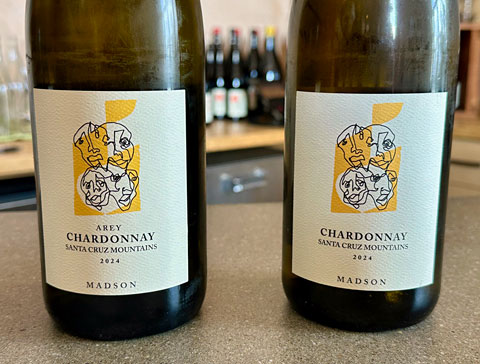
As we talked with Cole, he began opening up the bottles on the tasting bar that he’d selected for us to try. We first tried a couple of Chardonnays, starting with the 2024 Santa Cruz Mountains Chardonnay. This wine is a blend from six vineyards, all on the cooler ocean side of the main Santa Cruz Mountains ridgeline. The wine displayed lemon and stony mineral character, with a bright mouthfeel and a long, vibrant finish, a really nice appellation Chardonnay. We followed that wine with the 2024 Arey Vineyard Santa Cruz Mountains Chardonnay, from a vineyard site near Los Altos Hills. This had more of a pear and stone fruit profile along with citrus notes, showing greater depth, texture, and structure than the previous wine, but with similar fine acidity and long finish. Cole told us that they prefer to pick on the early side for their Chardonnays, and base picking decisions more on pH (aiming for about 3.1) than on brix (this usually ends up around 21). With such a low pH, and the fact that fruit from these cooler vineyard sites can ripen late in the season when it’s cold inside the winery, it was no surprise when Cole told us that the wines often don’t finish either primary or secondary fermentation for many months after harvest.
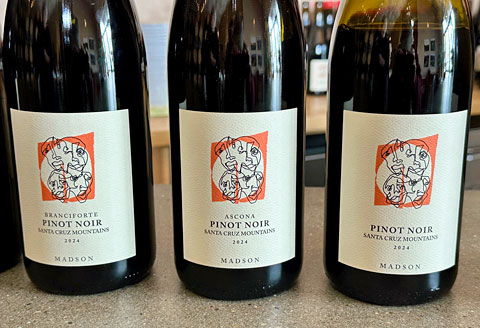
Moving on to reds, Cole poured us the 2024 Santa Cruz Mountains Pinot Noir. Sourced from four vineyards and fermented with whole clusters, this was made from a mix of various Pinot clones and spent a little under 12 months in barrel. With earth and forest floor notes upfront and black cherry fruit plus spice in support, this medium-bodied wine had good structure and youthful tannins on the finish. Next was the100% Pommard clone 2024 Ascona Vineyard Santa Cruz Mountains Pinot Noir, which was entirely whole-cluster fermented and then barrel-aged for about 11 months. This featured more red fruit along with spice and savory herbal aromas – another Pinot that’s tasty now and should develop nicely with a few years in the cellar.
We tasted two more 2024 Pinots with Cole, neither of which has been released yet. The 2024 Branciforte Vineyard Santa Cruz Mountains Pinot Noir, which will be released this fall, came entirely from low yielding (about one ton per acre) Pommard clone fruit grown on calcareous sandstone soil. Like the other Pinots, this was fermented with whole clusters, and the wine was aged in barrel for about 18 months. Cole told us that the vineyard had been planted in 1989 for David Bruce, and later Jeff Emery sourced this fruit for many years. Jeff eventually split the fruit from there with Madson, and they’ve been able to take the entire crop from Branciforte after 2022. The wine had loads of earth, spice, forest floor, and red cherry aromas, with terrific texture and structure – another Pinot worth aging. Our final Pinot was the 2024 Toyon Vineyard Santa Cruz Mountains Pinot Noir, to be released next spring – this features Pommard, Swan, 115, 667, and 777 Pinot clones. The vineyard was planted in 2002, and Madson has been farming it since 2018. This displayed more upfront fruit along with savory and spice notes, with fine acidity and grippier tannins on the finish.
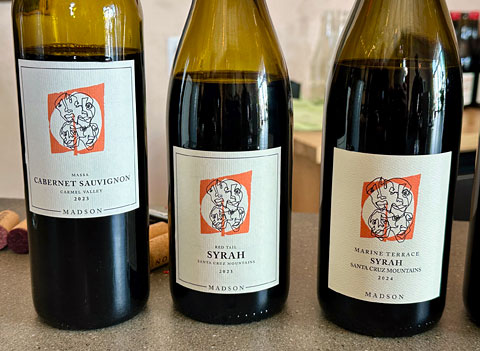
Although Cole was running on a tight schedule the day of our visit he was able to taste us on three more reds. The 2024 Marine Terrace Vineyard Santa Cruz Mountains Syrah came from a site that’s only a few miles from the ocean, and was made with the rare Serine selection of Syrah. Whole-cluster fermented and then aged in a single puncheon, this is the first vintage of this wine for Madson. Dark berry fruit, savory herbs, and hints of black olives, with a bigger mouthfeel and plenty of tannin – still very young but with great promise, and it deserves time in the cellar to develop more fully. Cole poured us one more Syrah, the 2023 Red Tail Vineyard Santa Cruz Mountains Syrah. The Syrah fruit at this site originated with vine cuttings taken from Côte-Rôtie, and it was – surprise! – entirely fermented with whole clusters. Showing both red and black fruit aromas plus floral and herbal components with great structure – the tannins are a bit more approachable right now than the previous wine but it should also benefit from more aging.
Our final Madson wine of the day was the only one not sourced from the Santa Cruz Mountains, the 2023 Massa Vineyard Carmel Valley Cabernet Sauvignon, from a site planted in 1968. Unlike the other reds we tried, the fruit for this one was all destemmed. This was a terrific old-school California Cabernet, featuring upfront herbal aromas, black currant and plum fruit, earth, and spice, with marvelous texture and firm but not astringent tannins on the finish – another wine that’s already delicious but really deserves cellaring to show its full potential.
In addition to the wines we tasted with Cole, other current and recent Madson wines have included Pét-Nat Rosé, Aligoté, Chenin Blanc, Riesling, Gamay, Sangiovese, Cabernet Franc, plus additional Chardonnay, Pinot Noir, and Syrah bottlings. Total annual production ranges from around 3,500 to 4,500 cases. I asked Cole whether they have any new projects in the works for Madson, and he said that they’re grafting Chenin Blanc and Aligoté at several vineyard sites.
It would have been nice to spend more time with Cole – and to visit with Ken and Abbey too – but we were glad that he was generous enough to take an hour out of his busy schedule to talk with Wes, Larry, and me and to pour us so many of the Madson wines for us. These were very impressive wines across the board, and I think that Madson is producing some of the best you’ll find from the Santa Cruz Mountains. The Chardonnays we tasted had wonderful acidity and great balance, and while the whole-cluster character definitely came through in the Pinots and Syrahs, it wasn’t overdone – again, everything was in balance. The wines showed more complexity than you might expect for being so young and they also had plenty of potential for aging. I particularly liked both 2024 Chardonnays – with an edge to the Arey Vineyard bottling – along with the 2024 Ascona Vineyard Pinot Noir, 2024 Branciforte Vineyard Pinot Noir, and 2024 Marine Terrace Vineyard Syrah. Although I liked all of the wines we tasted with Cole, I thought the star of the show was the 2023 Massa Vineyard Cabernet Sauvignon – that was a real knockout. If you’re a fan of Santa Cruz Mountains wines, you owe it to yourself to stop in at the Madson tasting room or look for their bottles at your local wine shop.
Margins Wine
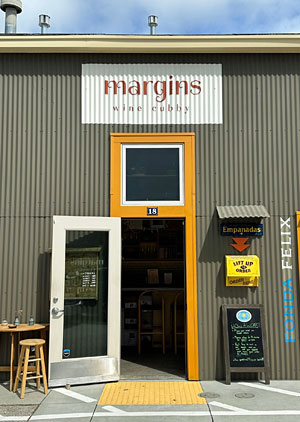
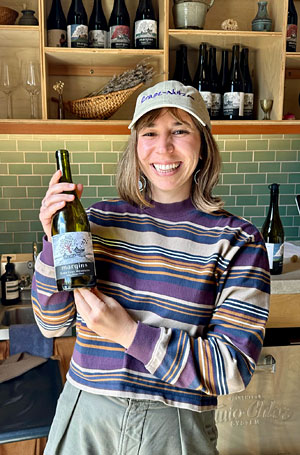
Wes, Larry, and I didn’t have far to travel to our next wine visit of the day. Margins Wine was just down the street, and after finding a parking spot we walked over to the Margins “Wine Cubby.” There we were welcomed in by Margins owner/winemaker Megan Bell. I’ve met Megan on a number of occasions over the past 6-7 years, and tried to arrange a visit with her a couple of times in the past two years but we weren’t able to coordinate a date that worked for both of us. So I was very happy that I was able to visit her on this occasion, especially given the news I’d heard a couple of months earlier that she would be closing down the Margins wine label. It’s no secret that the past few years have been particularly difficult ones in the wine business, and Megan is not the only vintner I know who is either in the process of shutting down or has already done so, but hearing about her closure hit me especially hard.
Megan grew up in the San Francisco Bay Area and earned a degree in viticulture and enology from UC Davis in 2012. Following that, she worked in wineries and vineyards in a number of locations, including Napa and Livermore Valley in California, Willamette Valley in Oregon, Central Otago in New Zealand, and the Loire Valley in France. Returning to the Santa Cruz region, she became the assistant winemaker of Beauregard Vineyards. She launched her Margins label in 2016 with a modest production of Chenin Blanc, one of her mainstay grape varieties over the years, and making her early vintages at Beauregard. More recently she’s been making her wines in a shared facility in the Watsonville area with James Jelks of Florèz Wines. Megan opened her tiny – only about 120 square-foot! – Wine Cubby in Santa Cruz in December 2023. She decided not to make any wine in the 2025 vintage as she’d already begun to wind down her business, so 2024 is the final Margins vintage. Why the name Margins? Her focus is on underrepresented grapegrowing regions, vineyards, and to a significant extent, grape varieties as well – all things that are still on the margins of the California wine world.
|
| Megan Bell, with Wes and Larry |
Megan has sourced her fruit from a number of organically-farmed vineyards, and unsurprisingly, most are located in lesser-known California winegrape growing regions, including Santa Clara Valley, Clarksburg, Contra Costa County, Arroyo Seco, Carmel Valley, San Benito County, and Paicines, in addition a few in the Santa Cruz Mountains. She’s worked with a number of growers to convert their vineyards to organic farming, a growing movement that she’s proud to have been a part of. Megan has helped farm Makjavich Vineyard in the Santa Cruz Mountains since 2019 along with vineyard owner Larry Makjavich, and she’s gotten Pinot Noir, Cabernet Franc, and Merlot from the site, which is now certified organic. A vineyard that she’s been particularly excited about in the past few years is Paicines Ranch in San Benito County, one of just a small number of California vineyards practicing regenerative agriculture.
Megan’s winemaking practices at Margins have been low-intervention from the start, and most would consider her wines to be “natural wines” as they undergo native fermentations, the only thing she adds during the process is a minimal amount of SO2, and her wines are never fined or sterile-filtered. Over the years I’ve tasted plenty of natural wines, and Megan’s consistently have been among the cleanest ones I’ve tried. Making natural wines as clean as these is a testament to the skill and care that have gone into Megan’s winemaking. All of the Margins red wines are made with entirely destemmed fruit – Megan told us that she doesn’t like whole-cluster character in her wines. Most of her wines are aged in older oak barrels, along with some stainless drums plus one concrete egg that she’s used for her Chenin Blanc. By and large, Megan makes her wines for drinking on release or with short-term cellaring rather than for extended aging.
In recent years Megan has worked with over 20 grape varieties in each vintage. Varieties have included Chenin Blanc, Aligoté, Assyrtiko, Verdejo, Vermentino, Muscat Blanc, Pinot Noir, Barbera, Sangiovese, Nebbiolo, Sagrantino, Counoise, Grenache, Mourvèdre, Négrette, Cabernet Franc, Merlot, and more – most of those varieties are not widely-planted in California. Total annual production topped out at around 2,800 cases, and with over 20 different wines released each year, every one of them was made in fairly small quantities. Almost all of the Margins wines are made with earlier drinking in mind rather extended aging.
A wine that’s been particularly important to Megan is her “Guardian Vital” – she produced this bottling in two vintages. The Guardian Vital Project is a joint effort of The Vinguard and of Líderes Campesinas – this organization helps to create public awareness of and to advocate for women farmworkers in California. Specific criteria for treatment of vineyard workers must be met for wines made with grapes from these vineyards to qualify for the label. The Guardian Vital wines have only been around for a couple of years, but it seems like this project is growing and attracting more vintners to make wines to benefit the worthwhile programs of Líderes Campesinas.
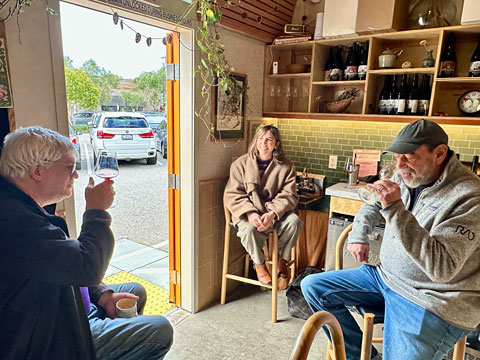
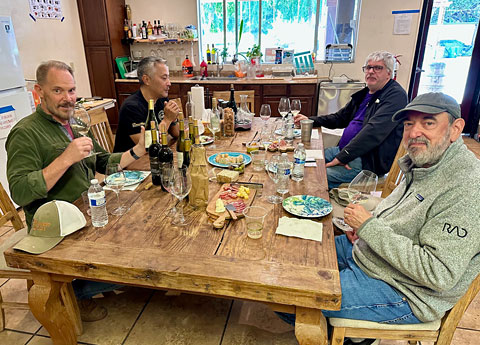
Wes, Larry, and I took seats in the Wine Cubby to talk with Megan. The small size of the space helps in having people interact there, and Megan’s goal in choosing that particular space was to help foster a sense of community. She’s credited Margins’ direct sales manager Melissa Russi for working with her to do just that at the Wine Cubby. Megan told us that she feels that the wine business is particularly good at bringing people together, and I certainly find that to be the case. Megan is proud of the relationships she’s built during her years in the wine business, and it seems like those relationships are things that she’ll be glad to continue even after closing Margins. She’s also proud of helping to bring people into the wine industry for the first time through internships at Margins, putting a focus on allowing them to learn and grow from their experience there and to move on to other wine positions afterwards.
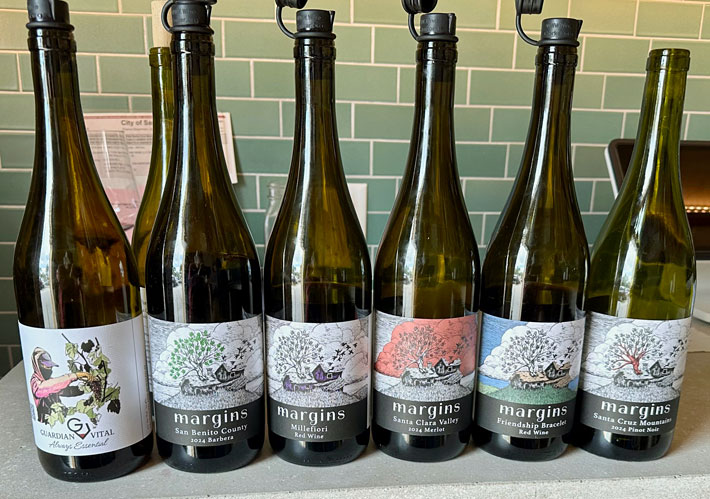
As we talked with Megan, she poured us some of her most recent wines. Since her announcement that she was closing down her label, she’s sold out of all of her white wines, so we tasted only reds on this visit. We began with the 2024 California “Friendship Bracelet” Red Wine – this is a blend of mostly Sangrantino and Chenin Blanc, plus smaller percentages of Mourvèdre, Merlot, and Cabernet Franc. I’ve seen a lot more wines that blend both white and red grape varieties over the past ten years. The wine displayed upfront red fruit aromas and maybe a touch of stone fruit, with savory notes in the background and with lighter body and fine acidity – a lively and fun blend that would be perfect to chill down a bit for warm weather drinking. Next was the 2024 Makjavich Vineyard Santa Cruz Mountains Pinot Noir, from the steep, cool, and windy site that Megan helped farm over six vintages. A floral, herbal, and red-fruited Pinot, this had lighter weight on the palate with bright acidity and a long finish.
We followed up with the 2023 Santa Cruz Mountains “Rugged Heart” Red Wine, a blend from Makjavich Vineyard of around 45% each Merlot and Cabernet Franc plus a little Cabernet Sauvignon and Petite Sirah. We noted the surprisingly light color of the wine given the grape varieties, and Megan told us that it was on the skins for only two or three days before being pressed. With red fruit and spice aromas, this was another lighter-bodied wine that displayed vibrant acidity. Megan then poured us the NV Central Coast “Millefiori” Red Wine, which is a blend of 50% each 2023 Mourvèdre and 2024 Merlot. This showed more savory herbal character upfront with both red and black fruit and floral notes in support, medium weight with a lively mouthfeel and finish – very tasty now and with the potential to develop nicely with a year of two in the cellar. One more Merlot-based wine was the 2024 Santa Clara Valley Merlot, which is 100% varietal. Red cherry fruit, fresh herbs, and a touch of spice, with a bright texture and finish, a distinctive lighter rendition of Merlot.
We next tasted the NV California Guardian Vital. As mentioned above, this is the second rendition of this wine for Margins, and it’s a blend of equal parts Grenache, Cabernet Franc, and Merlot. Displaying a more earthy profile along with red fruit and herbs, this had a bit more structure for aging than the other Margins wines we tasted. Our final wine of the day at Margins was the 2024 Calleri Vineyard San Benito County Barbera, with fruit sourced from one of the Silleto family vineyard sites near Tres Pinos. Plenty of upfront red fruit along with earth and spice notes, this had vibrant acidity, medium body and fine texture, with a long, bright finish.
I asked Megan whether she has any plans for the future after Margins closes down, and she does have some things in mind but wants to wait to make any announcements. I also asked whether she would want to start up her own wine label again in the future, and although she wouldn’t rule it out, she didn’t sound overly enthusiastic about the idea, at least not at this point. I’m sure that the ongoing process of closing Margins is a bittersweet time for Megan but she genuinely seemed more relieved than sad about it, glad to be getting out from under the financial strains of running her business.
As mentioned above, while I’m sad to see any vintners I know decide they need to close down, I’m particularly sad to see Margins close. I’ve loved Megan’s wines from the first time I tasted them – the freshness and light touch on all of her wines is so distinctive. I appreciate the thought and care that she’s put into her business, from how she’s helped people into the wine industry to her part in the Guardian Vital wine project. And I really relate to her focus on California wine regions, vineyards, and grape varieties that are on the margin, as this was very similar to my own experience working for a few small wineries over the years. I’ve always enjoyed talking with Megan at various wine tasting events over the years, and the opportunity to talk more with her at her Wine Cubby was even more fun. She almost always seems to be smiling, and maybe more so now that the pressure of running her wine business is lifting from her shoulders. I enjoyed all of the wines that Megan poured for Wes, Larry, and me, but if I had to choose a few favorites, the 2024 California “Friendship Bracelet,” NV Central Coast “Millefiori,” 2024 Santa Clara Valley Merlot, and 2024 Calleri Vineyard Barbera would be my picks. Wishing Megan the best in her future endeavors, and be sure to buy some Margins wine before it’s all gone!
Larry had scoped out a few options that looked like they might be good for our lunch stop, and we chose Santa Cruz Mountain Brewing, conveniently located right around the corner from the Margins Wine Cubby. In addition to a nice selection of beer, which they brew there, they offer a few sandwiches and other options, and we made our choices and ordered at their counter. There’s a sizable covered outdoor seating area but it seemed a bit noisy so we opted for seats at one of the small number of indoor tables. I got a Cubano sandwich and their “Coaster Kölsch.” We didn’t have to wait too long for a server to bring our food out to the table. The sandwich, which came with chips and a pickle spear, was large and very tasty. The beer was good though unexceptional, but it went nicely with the sandwich and it definitely hit the spot after a morning of wine tasting. I’d certainly consider stopping for lunch again at Santa Cruz Mountain Brewing next time I’m in the area. Wes, Larry, and I had built a little extra time into our schedule for the day so we weren’t rushed and were able to enjoy a relaxing lunch before taking off for our next wine visit.
Deauratus Wines
|
| Eric Baugher and Shun Ishikubo |
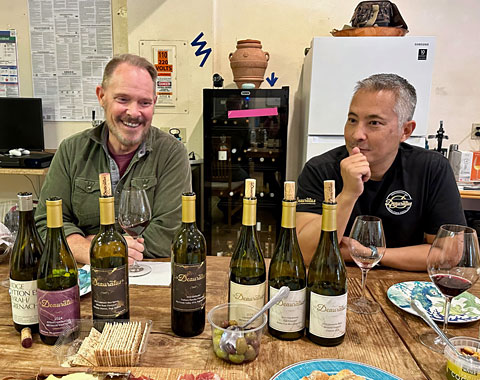
After lunch, we headed over the hills about an hour’s drive east of Santa Cruz for our final wine visit of the day, with co-proprietors and co-winemakers Eric Baugher and Shun Ishikubo of Deauratus Wines. Wes had suggested visiting with them as he’d already been in touch with Eric about tasting their wines. Eric and Shun make their wines at a custom crush facility in Gilroy, and after a little initial difficulty in finding their place, we parked outside and Eric came out to greet us and welcome us in.
Many people are familiar with Eric from his long tenure – over 25 years – at Ridge Vineyards where he made the famed Monte Bello bottlings as well as others. He grew up in Santa Cruz and went to college at UC Santa Cruz, studying biochemistry and molecular biology there before starting at Ridge in 1994. Shun is from Kagoshima in southern Japan, and he began his career working for a shochu distillery there. He eventually moved to California, and after earning a degree in viticulture & enology at UC Davis he worked for a sake producer in Berkeley and then at a Lodi custom crush facility before joining the Ridge Montebello team in 2008. Eric and Shun spent over ten years working together at Ridge before both moved on after the 2020 vintage. They worked together again in Napa Valley for a couple of years after that, but they ultimately realized that Napa wasn’t for them. After that, they decided it was time for them to establish their own wine label, and they founded Deauratus in 2023.
What does the Deauratus name mean? It comes from the Latin word for “golden” – it was indeed a golden opportunity for the two longtime friends and winemaking colleagues to launch their own wine label, and they’re confident that the quality of their wines is golden as well. With 20 years of working in California wineries for Shun and over 30 years for Eric, they’re able to draw on their long experience to select from vineyard sites they feel are exceptional, and all of the Deauratus wines are labeled as single-vineyard bottlings to reflect this. The first vintage of Deauratus came in 2023, and Eric and Shun have worked to source from vineyards they believe will provide them with not only top-notch fruit, but also fruit that will help them craft wines that match their vision. In addition to high-quality fruit, they’re also committed to the same quality in their packaging. They use the best-quality natural corks they can find for their wines – their corks are individually tested to virtually eliminate the risk of cork taint. They also mentioned that their wine labels are specially made so that they will not peel off when bottles are placed in ice buckets, as many other labels do.
Deauratus is working with several noted vineyards on the Central Coast as well as in Napa. They source Grenache Blanc, Chardonnay, Grenache and Syrah from the sandy limestone- and granite-based soil of Michaud Vineyard in the Chalone AVA, and they bring in Zinfandel from 100+ year old Dusi Ranch in Paso Robles. They’ve also been sourcing Bordeaux grape varieties from a site on Mount Veeder, in the mountains west of Napa Valley. During our visit, Eric and Shun spoke of exploring different California terroirs and of trying out different ideas in their wines.
|
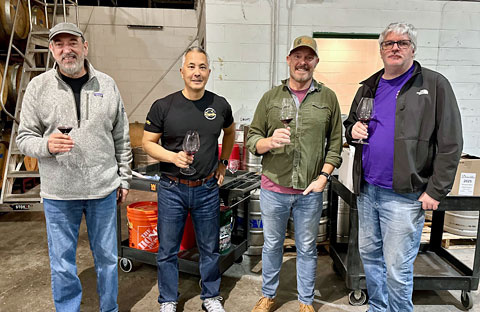
| Larry, Shun, Eric and Wes |
Eric and Shun set up Deauratus with an Alternating Proprietorship (AP) license at the custom crush facility in Gilroy, which ensures that they are the only ones who touch their fruit and their wine from harvest through bottling. This enables them to maintain tight control over every aspect of their winemaking process as well as making sure that cleanliness and sanitation are up to their high standards. Winemaking at Deauratus largely follows the lower-intervention model of Ridge, including native fermentations. Most fermentation for Deauratus wines takes place in temperature-controlled stainless steel tanks. With their background at Ridge, it’s no surprise that Eric and Shun favor American oak for aging their wines, though they do also use some French oak – they use both new and older barrels. Red wines are typically racked every 3-6 months during barrel aging. The custom crush facility has their own bottling line, which makes it more convenient for Eric and Shun to bottle their wines when they want to.
The Deauratus wines are made in relatively small lots, and overall annual production – currently about 1,100 cases – enables Eric and Shun to do everything themselves. They told us that they’d like to grow their production but ideally they would like to keep it small enough that they can continue to do all of the cellar work on their own. In addition to selling their wines in the US, they also currently export some to the UK and Japan.
Eric and Shun led Wes, Larry, and me back into the large winery space and started off our tasting with a few of their 2025 vintage wines from barrel. The Deauratus barrels are in one corner of the space, separate from other barrels at the facility. We began with the 2025 Michaud Vineyard Chalone AVA Chardonnay, which had just finished malolactic fermentation – this had stone fruit and spice notes with great acidity. We followed that with the 2025 Dusi Ranch Paso Robles Zinfandel. While there are some other red varieties interplanted in the old vineyard (Carignane, Petite Sirah, probably others) it’s predominantly Zin. Showing brambly Zin fruit, spice, and undertones of oak, this also had fine acidity, with a tasty finish. Next was the 2025 Michaud Vineyard Chalone AVA Syrah/Grenache, a co-fermented blend of 50% of each grape variety. With savory and slightly meaty dark berry fruit, it had plenty of structure and youthful tannins.
We then tasted two 2025 barrel samples from the vineyard on Mount Veeder that Deauratus has been sourcing from since 2024. Eric had been working with fruit from this site while he was making wine in Napa Valley in 2021 and 2022, and was happy that he and Shun had been offered it for their own label. The 2025 Mount Veeder Merlot is 100% varietal. This wine had intense cherry and spice aromas with medium-full body and youthful tannins. The 2025 Mount Veeder Cabernet Sauvignon includes about 75% Cabernet Sauvignon plus Merlot, Cabernet Franc, and Petit Verdot. It featured more spice notes along with savory herbs and a darker fruit profile than the Merlot, with a bigger mouthfeel and grippy tannins – of course it’s still very young but this barrel sample in particular showed terrific potential.
We continued with a couple of 2024 barrel samples from the Mount Veeder site, beginning with the 2024 Mount Veeder Merlot, which will be bottled soon. It displayed red fruit plus notes of anise, herbs, and cedary oak undertones, with a firm tannic finish. We finished our barrel tasting with the 2024 Mount Veeder Cabernet Sauvignon, which has a very similar blend to the 2025 vintage though with a touch more Cabernet Sauvignon and Merlot and less Cabernet Franc and Petit Verdot. This had somewhat more herbal aromas upfront along plus darker berry fruit framed by sweet oak notes, with full body and plenty of structure.
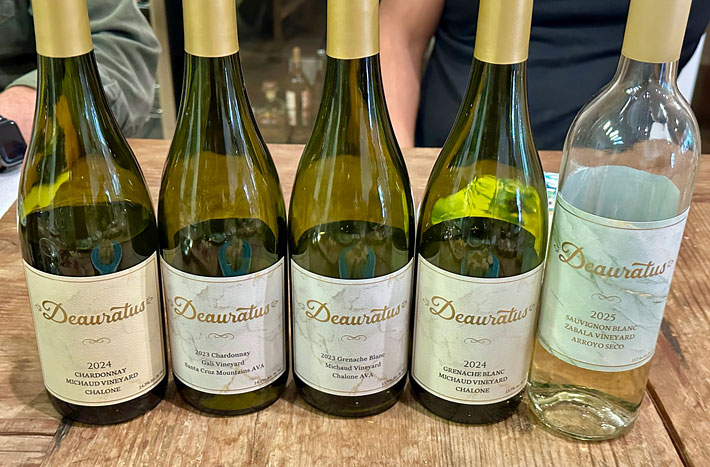
After tasting the barrel samples with Eric and Shun, we sat down with them at a large rustic wooden table in the facility’s kitchen to taste their bottled wines. We began with a new release, the 2025 Zabala Vineyard Arroyo Seco Sauvignon Blanc, from a site with lots of the river rocks characteristic of the region. This is the first Sauvignon Blanc release from Deauratus, and was made and packaged a bit differently from their other wines. Fermented mostly in stainless steel, bottled early and with a screwcap closure, it’s meant for early drinking. Eric and Shun do bâtonnage on their white wines to help bring out both aromatics and mouthfeel, even doing bâtonnage in tank for the Sauvignon Blanc. The wine displayed fresh herbal – but not grassy – citrus and stone fruit aromas, medium body, and combining more texture than you’d expect from this variety with a lively finish. We followed that with the 2023 Michaud Vineyard Chalone AVA Grenache Blanc. With apple and stone fruit on the nose and hints of flowers and spice, this also had medium weight on the palate with fine acidity and a long finish.
Eric and Shun next poured us the 2023 Gali Vineyard Santa Cruz Mountains Chardonnay, from a vineyard site on the coastal side of the mountains, with sandy soil. The two had made wine for Gali Vineyards in Watsonville after they’d moved back to the area after their time in Napa Valley. This showed stone fruit and tropical fruit aromas with sweet oak undertones, and a moderately rich texture and creamy finish. We then tasted the 2024 Michaud Vineyard Chalone AVA Grenache Blanc, which provided us with the opportunity to compare it to the 2023 vintage we’d tried. Being a year younger, it was not surprising that this one featured fresher fruit aromas, with upfront tropical fruit plus herbal notes, and a vibrant mouthfeel and finish. While Wes preferred the 2023 vintage of this wine, Larry and I favored the 2024. Our last white wine was the 2024 Michaud Vineyard Chalone AVA Chardonnay – everything about it was stony, from the stone fruit aromas to the stony mineral character it displayed along with spice and oak notes in support, with great texture and a long, lively finish.
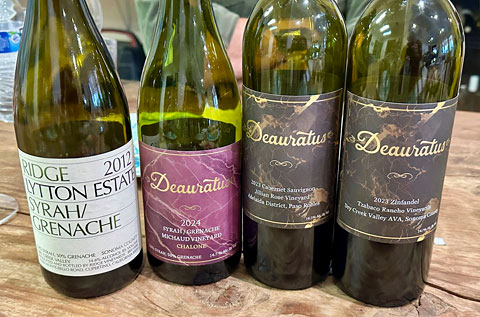
Moving on to red wines, Eric and Shun opened their 2023 Tzabaco Rancho Dry Creek Valley Zinfandel. This vineyard is on land that’s been farmed by generations of the same family since the 1850s. Bright and earthy, with red fruit, lots of spice, a touch of black pepper, nicely-integrated oak notes, and showing fine structure. The 2023 Jillian Rose Vineyard Adelaida District Paso Robles Cabernet Sauvignon came from a site that’s been focused on growing Cabernet – this had beautiful aromatics, with herbal currant and darker berry fruit, savory and spicy components, and cedary oak in support, with medium-full body and firm tannins. We tasted one more Deauratus red, the 2024 Michaud Vineyard Chalone AVA Syrah/Grenache. As with the 2025 barrel sample we’d tasted, this is 50% each Syrah and Grenache that were co-fermented. Featuring ripe red and black fruit aromas along with savory and earthy elements and sweet oak notes in the background, this had plenty of structure and a tasty finish.
Eric and Shun had generously poured us the entire lineup of 2023 and 2024 Deauratus wines that they’ve released to date, and they had a surprise in store for us at the conclusion of our tasting – a mystery wine! They poured us this one, which was in a bottle concealed in a brown bag, and asked us to guess what it was. Although none of us quite nailed it, we did correctly guess it was an older Ridge wine, and when Eric revealed the bottle, it turned out to be the 2012 Ridge Lytton Estate Dry Creek Valley Syrah/Grenache. He noted that this was the last vintage that Ridge produced this bottling. Savory red and black fruit plus earth and spice notes, with great texture and nicely resolving tannins – showing well right now but certainly can stand up to additional cellaring.
I checked with Eric about any new projects that he and Shun are working on for Deauratus, and he mentioned that they continue to search for mountain vineyard sites (such as at Michaud and Mount Veeder), and especially for those with limestone soil, which is relatively rare in California. He also said that they’d love to make a Super-Tuscan style blend – typically Sangiovese and Cabernet Sauvignon – if they can find the right vineyard to work with for that.
Wes, Larry, and I had a great time talking with Eric and Shun and it was so generous of them to pour so many of their wines for us to taste, both barrel samples and bottled wines. There’s little doubt that the Deauratus wines will attract fans of Eric’s and Shun’s past work at Ridge, and while there are certainly similarities between those Ridge wines and the new Deauratus ones, they’re definitely not the same. The winemaking style at Deauratus will feel fairly familiar to Ridge fans, but the vineyard sites (with the exception of Dusi Ranch) are different and there’s more than enough distinction to make the Deauratus wines unlike Ridge or any other I can think of. Only three vintages into their new project, Eric and Shun have already pointed the way for their wines’ direction. Overall I found the Deauratus wines to be an intriguing and appealing combination of boldness and subtlety. My favorites among the barrel samples we tasted were the 2025 Dusi Ranch Zinfandel, 2025 Michaud Vineyard Syrah/Grenache, and both the 2025 and 2024 vintages of Mount Veeder Cabernet Sauvignon. For the bottled wines, I particularly liked the 2025 Zabala Vineyard Sauvignon Blanc, 2024 Michaud Vineyard Grenache Blanc, 2024 Michaud Vineyard Chardonnay, and 2023 Jillian Rose Vineyard Cabernet Sauvignon. Whether you’re a longtime Ridge fan or coming to these wines from a different perspective, the Deauratus wines are well worth checking out.
This was such a fun day! Wes, Larry, and I visited three wineries making wines with very different styles from one another. In fact they couldn’t have been much more different, yet they were all quite impressive. We had a wonderful time talking with all four of the talented winemakers we visited. I have to thank Larry again for driving – I typically drive on these long one-day wine trips and it was nice to get a day off from that this time.
I’ve really liked the wines that Cole has made at Madson and that Megan has made at Margins for a number of years but this was my first experience with Deauratus – though of course I’d tasted plenty of wines that Eric and Shun had made in the past. It’s not always the case that I like every single wine I taste on a day’s worth of wine visits, but on this day I really did enjoy them all.
If you haven’t already discovered the wines from Madson and from Deauratus, now’s the time to do it. And though the Margins label is closing down, there should still be a little time to get some bottles before they disappear. As always, thanks to everyone that I visited for being so generous with their time and their wine!
|